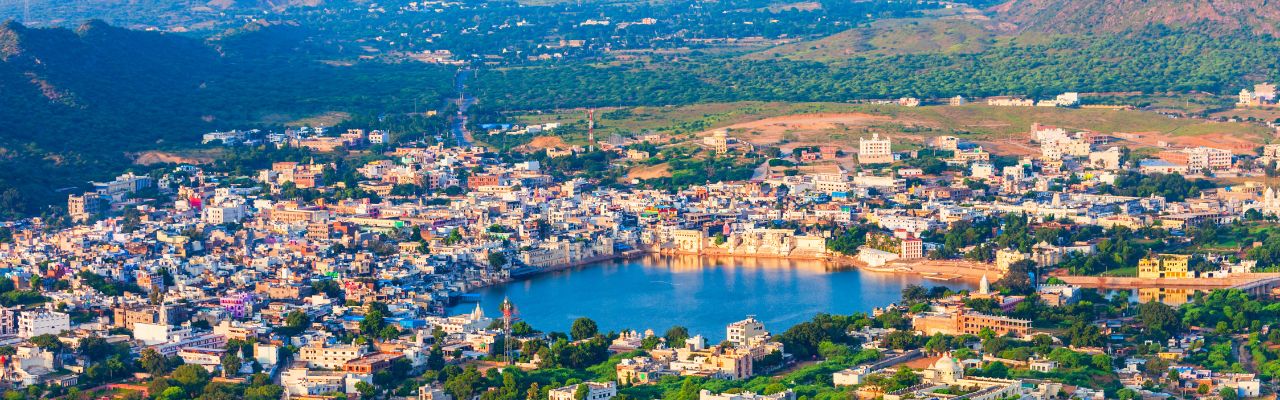
Pushkar is a temple town near the city of Ajmer and the headquarters of Pushkar Tehsil in Ajmer district in the Indian state of Rajasthan. It is located about 10 km (6.2 mi) northwest of Ajmer and about 150 kilometres (93 mi) southwest of Jaipur. Pushkar has many temples. Most of the temples and ghats in Pushkar date from the 18th century and later, as many temples were destroyed during the Muslim conquest of the region. Subsequently, the destroyed temples were rebuilt. The most famous of the Pushkar temples is the red-spired Brahma Temple. It is considered a holy town by Hindus, especially in the Shakti sect, and the consumption of meat and eggs in the town is prohibited, as is alcohol and intoxicants. Pushkar is located on the banks of the Pushkar Lake, which has many ghats where pilgrims bathe.6

This article is about city in Rajasthan. For annual festive fair, see Pushkar Fair. For other uses, see Pushkar (disambiguation).
Pushkar Fair, The Pushkar Fair, also called the Pushkar Camel Fair or locally as Kartik Mela or Pushkar ka Mela is an annual multi-day livestock fair and cultural fête held in the town of Pushkar near Ajmer city in Ajmer district in (Rajasthan, India). The fair starts with the Hindu calendar month of Kartik and ends on the Kartik Purnima, which typically overlaps with late October and early November in the Gregorian calendar. In 1998, over 1 million visitors came to Pushkar throughout the year. The Pushkar fair alone attracts over 200,000 visitors.
Etymologically, Pushkar appears after the monsoon. In Sanskrit, Pushkar means "blue lotus flower."
Location
Pushkar is located in the central-eastern part of Rajasthan, on the western slopes of the Aravalli Range. The nearest airport to Pushkar is Kishangarh Airport, located about 45 km (28 mi) northeast. Pushkar is about 10 km (6.2 mi) from Ajmer and is connected by the Pushkar Road (Highway 58) that passes over the Aravalli Range. Ajmer is also the nearest major railway station.
Festivals and landmarks
Pushkar fair continues for five days and these five days are a period of relaxation and merry-making for the villagers. This fair time is the busiest time for them, as this is one of the largest cattle fairs in the country. Animals, including over 50,000 camels,[citation needed] are brought from distant places around to be traded and sold. All the camels are washed and adorned, some are shorn to form artistic patterns. Some camels, horses, and cows are colorfully decorated.
Sikh Gurdwaras,Pushkar is also a holy pilgrimage site for Sikhs, according to Gurmukh Singh, with gurdwaras dedicated to Guru Nanak and Guru Gobind Singh. These have historical roots, with the Guru Nanak gurdwara in the eastern part of the city being called the Guru Nanak Dharamshala, a popular name for Sikh shrines before the 20th century. The Sikh Dharamshala is a two-storey building with a central room surrounded by a veranda.
Pushkar Holi, celebrated in March, is one of the most important festivals of the Hindu calendar. It symbolizes the victory of good over evil and the arrival of spring. Holi is celebrated all over India and involves huge street celebrations. During Holi, bhang (ancient Indian cannabis) is served in Pushkar, which is known for the best bhang in India.
Other landmarks
Fairs
Map ( Click on the photo, the map will open )
Popular Pages on World Trip Plan