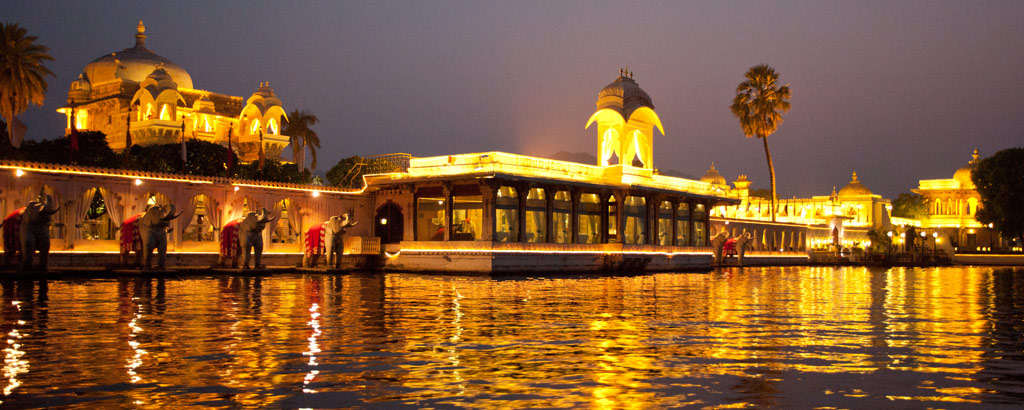
Jag Mandir is a palace built on an islet in Pichola Lake. It is also called the "Lake Garden Palace". The palace is located in the city of Udaipur in the Indian state of Rajasthan. Its construction is attributed to three Maharanas of the Sisodia Rajputs of the Mewar kingdom. The construction of the palace was started in 1551 by Maharana Amar Singh and was finally completed by Maharana Jagat Singh I (1628–1652). It is named "Jagat Mandir" in honor of the last Maharana, Jagat Singh. The royal family used the palace as a summer resort and a pleasure palace for holding parties. On one occasion, the palace served as a refuge for asylum seekers. It has Mughal style architecture.

History
The construction of the palace was started around 1616 by Maharana Amar Singh, continued by Maharana Karan Singh (1620–1628) and finally completed by Maharana Jagat Singh I (1628–1652). It is named "Jagat Mandir" in honor of the last-named Maharana Jagat Singh. The royal family used the palace as a summer resort and Anand Mahal for holding parties. The palace served as a refuge for asylum seekers on one occasion. During the rebellion in 1857, Maharana Swaroop Singh (1842–1861) saved several European families, mostly women and children from Neemuch, who were given refuge at the Jag Mandir Palace.
After India's independence from British rule, on 15 August 1947, at the initiative of Maharana Bhupal Singh, the state of Mewar merged with the Indian Union in 1949 along with other princely states of Rajasthan.
Construction
The construction work was started by Karan Singh [3] and was completed by Maharana Jagat Singh (1628-1652). Hence the name of this palace is Jagat Mandir or Jag Mandir.
Geography
Jag Mandir is located on one of the two natural islands at the southern end of Lake Pichola (named after the nearby village of Picholi). The lake was built in the 15th century by a local Banjara tribal chieftain to facilitate the transport of grain across the river. During the reign of Maharana Udai Singh II, in 1560, the lake was significantly enlarged by damming two streams. At that time, the Maharana also built the Jag Mandir and the Lake Palace (Jag Niwas Hotel) on islands in the middle of the lake. The city of Udaipur was built on the lake's shore, with its City Palace and other monuments and temples.
Structure
The impressive range of structures in the three-storey Jag Mandir Palace includes:
Gul Mahal, first built as a refuge for Prince Khurram;
The beautiful façade flanked by four carved statues of elephants on either side on the jetty entering the lake from Udaipur;
The garden courtyard and Darikhana on its northern side;
The Bara Patthar Ka Mahal (palace of 12 stones);
The Zanana Mahal - the southern extension of the Gul Mahal;
and the Kunwar Pada Ka Mahal.
These structures and the garden are described in detail below.
Gul Mahal
The Gul Mahal was the first structure built during the reign of Maharana Amar Singh in 1551, which was developed to house the Mughal prince Khurram (later Emperor Shah Jahan) during the reign of Maharana Jagat Singh. It was initially a small sandstone (yellow sandstone) palace with an imposing dome (which gives the impression of a crown). This dome has the crescent of Islam on top. Gul Mahal has three circular domed chambers one above the other. Entry to these chambers is through a pillared hall. Above the main façade are two marble chhatris with sloping cornices. The huge marble slabs on the inner walls were inlaid with coloured rubies, onyx, jasper, cornelian and jade. The palace is surrounded by a huge circular chamber made of white and black marble, on which are murals and paintings, which are considered an unusual feature in Rajput architecture. In the western part of the palace, this type of design is repeated in three other pavilions.
Jag Mandir
Jag Mandir is the main palace, which also comprises Gul Mahal. The minarets at the corners of the palace are octagonal and have domes on their top. A labyrinth of reception rooms, residential chambers and inner courtyards was built inside the palace, all built in Rajput and Mughal architectural styles. The zenana (residence hall of the royal women) adjoins the palace. The Kunwar Pada Ka Mahal (Yuvraj's Palace) is located at the western end.
Entry Pavilion
The pavilion at the entrance to the palace is an impressive white colonnade of pointed arches. The landing jetty is also located near the City Palace in Udaipur for docking for boats arriving from the Bansi Ghat jetty on the mainland. The cruise is through Lake Pichola. The pavilion is decorated with large elephants carved in stone, four on each side of the entry steps. They face the Lake Palace. The trunks of these elephants were damaged and replaced with polystyrene. The pavilion marks the perimeter of the island in the beautiful backdrop of the Aravalli Hills.
Garden
The flower garden in the palace complex is laid out in the spacious garden courtyard. It has yew bushes, jasmine, frangipani trees, bougainvillea, palm trees, nasturtium, verbena and moss rose. The courtyard itself is covered with black and white tiles. Fountains and water pools, surrounded by walkways with low marble railings, adorn the garden surroundings. The present Maharana hosts lavish parties here and also rents out the place for private parties.
Darikhana
The Darikhana is in the northern part of the palace, which is an open terrace built with marble columns. This place is now run as an eatery by the present Maharana.
Bada Patthar Ka Mahal
The Bada Patthar Ka Mahal is located in the eastern part of the main palace. The palace got this name because twelve solid marble slabs were used in its construction. Hence, it is also called the "Palace of Twelve Stones".
Gallery
Map ( Click on the photo, the map will open )
Popular Pages on World Trip Plan