City Palace Udaipur
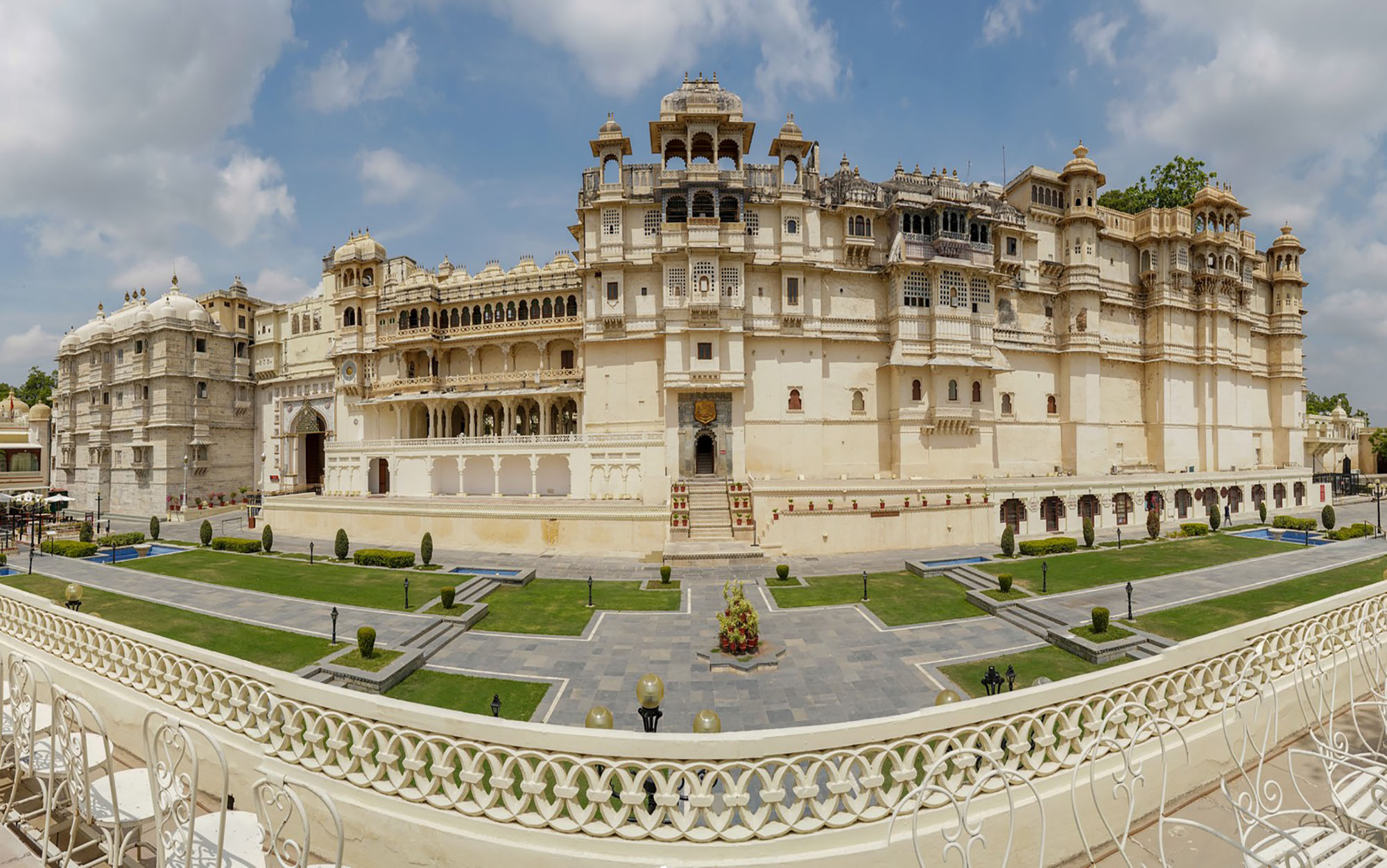
The City Palace (Raj Mahal), Udaipur is a palace complex located in the city of Udaipur in the Indian state of Rajasthan. With contributions from several rulers of the Mewar dynasty, it was constructed over a period of about 400 years. Its construction was started in 1553 by Maharana Udai Singh II of the Sisodia Rajput family, when he moved his capital from the then Chittor to the new city of Udaipur. The palace is located on the eastern bank of Lake Pichola and has several palaces built within its complex.
The City Palace in Udaipur was constructed in a grand style and is considered to be the largest palace of its kind in the state of Rajasthan. It was built on a hilltop in a blend of Rajasthani Rajput architecture, from where a panoramic view of the city and its surroundings is visible. Overlooking Lake Pichola, several historical monuments such as the Lake Palace, Jag Mandir, Jagdish Temple, Monsoon Palace and Neemach Mata Temple are located around the palace complex. Nestled within the Aravalli mountain range, these sites are also associated with popular culture.
History
The City Palace was built simultaneously with the founding of the city of Udaipur by Maharana Udai Singh II and his successors over a period of next 400 years. The Maharanas lived and governed their kingdom from this palace, making the palace complex an important historical site.
The Mewar kingdom initially flourished in Nagda (30 kilometres (19 mi) north of Udaipur), which was founded in 568 AD by Guhil, the first Maharana of Mewar. In the eighth century, the capital was moved to Chittor, a hill fortress from where the Sisodia dynasty ruled for 800 years. Maharana Udai Singh II inherited the Mewar kingdom in Chittor in 1537, but by that time there were signs of losing control over the fort in wars with the Mughals. Therefore, Udai Singh II chose the site near Pichola Lake for his new kingdom as it was surrounded by forests, lakes and the Aravalli Hills. He chose this place for his new capital on the advice of a sadhu he met during one of his hunting expeditions, much before Emperor Akbar invaded Chittor. [citation needed]
The first royal structure he built here was the royal courtyard or 'Rai Angan', which was the beginning of the construction of the City Palace complex. This court was built at the same place where the sadhu had advised the Maharana to build his new capital.
After the death of Udai Singh in 1572, his son Maharana Pratap assumed power of Udaipur. Later, after the death of Maharana Pratap in 1576 in the famous Battle of Haldighati against the Mughal Emperor Akbar, which ended in a stalemate, Amar Singh I assumed power of Udaipur.
But by 1761, due to the increasing attacks of the Marathas, Udaipur and the kingdom of Mewar were badly endangered and in ruins. By 1818, Maharana Bhim Singh signed a treaty with the British and accepted the protection of the British against other empires. After the independence of India in 1947, the Mewar Kingdom, along with other princely states of Rajasthan, merged into democratic India in 1949. The kings of Mewar also lost their special royal privileges and titles. However, subsequent Maharanas retained their ownership of the palaces of Udaipur and converted parts of the palace complex into heritage hotels.
In November 2024, clashes broke out outside the palace after Vishvraj Singh Mewar, who was formally anointed as the 77th Maharana of Mewar at Chittaurgarh Fort on 25 November 2024 following the death of his father Mahendra Singh Mewar, was prevented from entering the premises by his estranged uncle, Arvind Singh Mewar, who manages the trust that runs the property.
Architecture
The series of palaces in the City Palace complex were built on a ridge to the east of Lake Pichola, behind an outstanding façade of 244 metres (801 ft) in length and 30.4 metres (100 ft) in height. The complex is located at 24.576°N 73.68°E in the city of Udaipur, at an average elevation of 598 metres (1,962 ft). They were built over a long period, from 1559 onwards, by 22 generations of Sisodia Rajputs. Several Maharanas, starting with Udai Singh II, have contributed to the building, which consists of a group of structures including 11 small separate palaces. The unique aspect of this group is that the architectural design is clearly uniform. The interiors of the palace complex, which includes balconies, minarets and domes, display beautiful mirror-work, marble-work, mural paintings, frescoes, silver-work, inlay-work and stained glass remnants. The upper terraces of the complex offer views of the lake and the city of Udaipur.
The palaces within the complex are connected through several chowk or quadrangles with zigzag corridors, designed in such a way to avoid sudden attacks from enemies. After entering through the main Tripolia (triple) gate, the complex comprises Suraj Gokhda (public address façade), Mor-Chouk (peacock courtyard), Dilkhush Mahal (heart-pleasing palace), Surya Chaupad, Sheesh Mahal (palace of glass and mirrors), Moti Mahal (palace of pearls), Krishna Vilas (named after Lord Krishna), Shambhu Niwas (now the royal residence), Bhim Vilas, Amar Vilas (with an elevated garden) which is in front of Badi Mahal (large palace), Fatah Prakash Palace and Shiv Niwas Palace; the last two have been converted into heritage hotels. The entire complex is the property of the Mewar royal family and is looked after by various trusts.
Structures within the complex
Gateways
Gateways, colloquially called Pols, are set to the east of Udaipur city. A number of such gateways provide access to the palace complex.
The main entry from the city is through the 'Badi Pol' (Great Gate), which leads to the first courtyard. Badi Pol (built in 1600) leads to the ‘Tripolia Pol', a triple-arched gate built in 1725, which provides the northern entry. The road between this gate and the palace is lined with shops and kiosks owned by craftsmen, book-binders, miniature painters and textile dealers. Between these two gates, eight marble arches or Toranas are erected. It is said that the Maharanas used to be weighed here with gold and silver, which was then distributed among the local people. Following the Tripolia gate is an arena in front of the Toran Pol and the facade palace, the Manak Chowk, where elephant fights were staged in the past to test their prowess before starting on war campaigns.
The main block of the city palace is approached through a modest door from the Ganesha Deodhi terrace. The door is flanked by whitewashed walls vibrantly painted with martial animals in the traditional Rajput style. There is a big boulders in the entry where elephants were tied. This elephant parking has now become car parking.
Behind the entrance of Badi Pol there is a huge wall which was for the elephant fight. The elephant which touches the wall first would be considered weak elephant. Both elephants would pull each other in this fight.
Amar Vilas
Amar Vilas is the uppermost court inside the complex, which is an elevated garden. It provides entry to the Badi Mahal. It was built in Mughal style as a pleasure pavilion. It has cusped arcades enclosing a square marble tub. Amar Vilas is the highest point of the City Palace and has wonderful hanging gardens with fountains, towers, and terraces.
Badi Mahal
Badi Mahal (Great Palace) also known as Garden Palace is the central palace situated on a 27 metres (89 ft) high natural rock formation bis-a-bis the rest of the palace. The rooms on the ground floor appear to be at the level of the fourth floor in view of the height difference to its surrounding buildings. There is a swimming pool here, which was then used for Holi festival (festival of colors) celebration. In an adjoining hall, miniature paintings of 18th and 19th centuries are displayed. In addition, wall paintings of Jag Mandir (as it appeared in the 18th century), Vishnu of Jagdish temple, the very courtyard and an elephant fight scene are depicted.
Bhim Vilas
Bhim Vilas has a gallery of a collection of miniature paintings that depict the real-life stories of Radha-Krishna.
Chini Chitrashala
Chini Chitrashala (Chinese art place) depicts Chinese and Dutch ornamental tiles.
Choti Chitrashali
Choti Chitrashali or 'Residence of Little Pictures', built in the early 19th century, has pictures of peacocks
Dilkhusha Mahal
Dilkhusha Mahal or ‘Palace of Joy’ was built in 1620.
Durbar Hall
Durbar Hall was built in 1909 within the Fatehpraksh Palace as a venue for official functions such as State banquets and meetings. The gallery of the hall was used by the Royal ladies to observe the Durbar proceedings. This hall has a luxuriant interior with large chandeliers. Weapons of the maharanas and some of their portraits are depicted here. The foundation stone for this hall was laid by Lord Minto, the Viceroy of India, in 1909, during the rule of Maharana Fateh Singh and was then called Minto Hall.
Fateprakash Palace
Fateprakash Palace, which is now a luxury hotel, has a crystal gallery that consists of crystal chairs, dressing tables, sofas, tables, chairs and beds, crockery, table fountains which were never used. There is also a jewel studded carpet here. Maharana Sajjan Singh had ordered these rare items in 1877 from F& C Osler & Co of London but he died before they arrived here. It is said that the packages containing these crystals remained unopened for 110 years.
Manak Mahal
The Manak Mahal, accessible from Manak Chowk, is a ceremonial darshan complex for the Mewar rulers. It has a raised cornice completely inlaid with glass. The religious symbols of the Sisodia dynasty, gleaming brass sunflower symbols, are displayed repeatedly in several places in the City Palace, including one on the facade of the Manak Chowk. One of the largest such symbols can also be seen on the wall of the Surya Chaupad, a reception center on the lower floor. The Surya emblem of the Mewar dynasty depicts a Bhil, the Sun, the Chittor Fort and a Rajput, with a quote from the Bhagavad Gita (Hindu holy text) inscribed in Sanskrit, meaning "God helps those who do their duty". It was customary for the Maharanas to bow to the Sun every morning before having breakfast, facing the east.
Mor Chowk
Left:Three peacocks in Mor Chowk wall. Right: Pillared hall with glass and mirror mosaic decorations
Mor Chowk or Peacock square is integral to the inner courts of the palace. The elaborate design of this chamber consists of three peacocks (representing the three seasons of summer, winter, and monsoon) modeled in high relief and faced with coloured glass mosaic, built into successive niches in the wall area or jharoka, These were built during Maharana Sajjan Singh's reign, 200 years after the palace was established. The peacocks have been crafted with 5000 pieces of glass, which shine in green, gold, and blue colours. The apartments in front of the Chowk are depicted with scenes of Hindu god Lord Krishna's legends. At the upper level, there is a projecting balcony, which is flanked by inserts of coloured glass. In an adjoining chamber, called the Kanch-ki-Burj, mosaics of mirrors adorn the walls. The Badi Charur Chowk within this chowk is a smaller court for private use. Its screen wall has painted and inlaid compositions depicting European men and Indian women. Proceeding further from the Mor-Chowk, in the Zenana Mahal or women's quarters exquisitely designed alcoves, balconies, colored windows, tiled walls, and floors are seen.
Rang Bhawan
Rang Bhawan is the palace that used to hold the royal treasure. There are temples of Lord Krishna, Meera Bai and Shiva located here.
Sheesh Mahal
The Sheesh Mahal (Palace of Mirrors) in the City Palace of Udaipur was likely constructed during the reign of Maharana Udai Singh II, who founded Udaipur in 1559. It was later enhanced by successive Maharanas over the centuries.
Museum
In 1974, a part of the city palace and the 'Zenana Mahal' (Ladies Chamber) were converted into a museum. The museum is open for public.
In popular culture
The palace was picturised as a hotel in the 1983 James Bond film Octopussy, where Bond (played by Roger Moore) stayed as he began his quest to apprehend the antagonist Kamal Khan (Louis Jourdan).
A 1991 documentary film directed for television by Werner Herzog called Jag Mandir consists of footage of an elaborate theatrical performance for the Maharana Arvind Singh Mewar at the City Palace staged by André Heller.
The palace was used for filming part of Goliyon Ki Raasleela Ram-Leela (English: A Play of Bullets: Ram-Leela) 2013 directed by Sanjay Leela Bhansali. On 15 August 2018, India Post issued a commemorative stamp depicting the Palace.
The palace area of Manak Chowk serves as the venue of the annual Maharana Mewar Foundation Awards, honouring students, national and international personalities.
Gallery

Map ( Click on the photo, the map will open )

