Ahar Cenotaphs Udaipur

Ahar Cenotaphs Udaipur

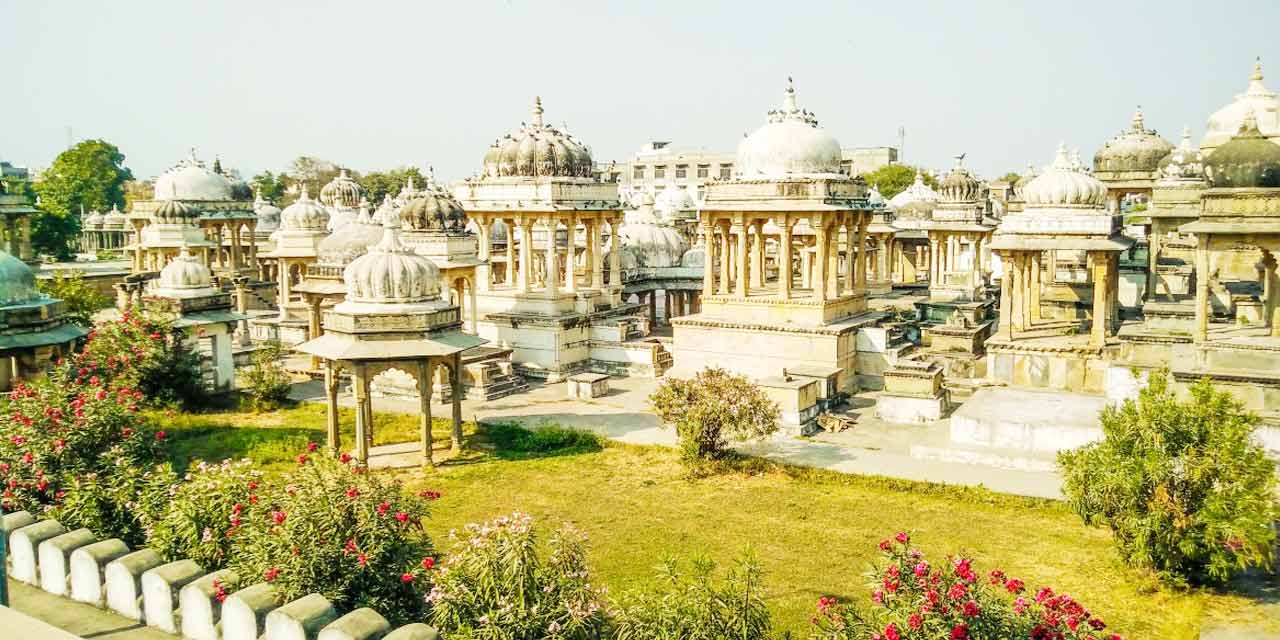
The Ahar Cenotaphs are a group of cenotaphs located in Ahar, Udaipur, Rajasthan, India. The site contains more than 250 elevated dome-shaped pavilions, or chhatris, of the royal house of Mewar, which were built over approximately 350 years. It has approximately 19 cenotaphs of various Maharanas who were cremated here. This group of cenotaphs is also known as Mahasati, or the "Great Place of Sati." It is also the place where, at times, the wives or concubines of the Maharana were either burned or committed sati with him. For this reason, the place is also known as Mahasati (transl.?Great Place of Sati).

These cenotaphs are arranged side by side in a vast enclosure and vary in size, ranging from a small chhatri with four columns to a mahal. Despite differences in layout and details, they all follow the same basic design. Each structure features a dome supported by columns, forming a circular pavilion. It is set on a raised terrace, accessed by a flight of steps. The entire structure, including the terrace, stairs, columns, and domes, is made of white marble from Kankroli. The most remarkable among these cenotaphs are those of Amar Singh and Sangram Singh II. These cenotaphs are built in the Jain architectural style.
 

Ahar Cenotaphs Udaipur (Entry Fee, Timings, History, Images & Location) -  Udaipur Tourism


History and significance, Udaipur


The ancient city of Ahar is located near the centre of the circular mountain valley that surrounds Udaipur and was historically known as Tamba Nagri under the rule of the Tonwar (Taoar) dynasty. During the reign of Asa Ditya of the Guhila dynasty, a new city called Anandpur was built on the ruins of Tamba Nagri, which gradually declined after Chittaurgarh became the new capital. The Ahar Memorials are a prominent group of royal chhatris located in the village of Ahar. These monuments are built in memory of the Maharanas of the Mewar dynasty and serve as the cremation site of the royal family. The tradition of cremating the Mewar rulers at Ahar began with Maharana Amar Singh I, who ruled from 1597 to 1620. His memorial is one of the earliest and most prominent structures in the complex. In total, there are nineteen major mausoleums commemorating various Maharanas, including Sangram Singh, Swaroop Singh, Shambhu Singh, Fateh Singh, Bhupal Singh, Bhagwat Singh Mewar and Sajjan Singh. The site is also called "Mahasati" or "Great Site of Sati", as it was the site of self-immolation by the queens and concubines of the late rulers. The effigies at the site symbolize the women who committed sati along with the kings.


Archaeological context and modern development 

Adjacent to the mausoleums is the Ahar Archaeological Museum, which houses rare artifacts and relics, including pottery dating back to 1700 BCE and a 10th-century metal statue of the Buddha. These exhibits highlight Ahar's ancient historical significance beyond its royal association. The ruins of this ancient city, known as Dhul Kot ("Fort of Ashes"), have yielded inscriptions and coins dating back to the tenth century. The area also contains the remains of Jain and Hindu temples with notable stone carvings. In the 1990s, Arvind Singh Mewar led efforts to restore several mausoleums in the complex. He was cremated here in March 2025, continuing the tradition of royal cremation at Ahar.


Gallery 


Map  ( Click on the photo, the map will open )


Popular On WTP

Popular Pages on World Trip Plan