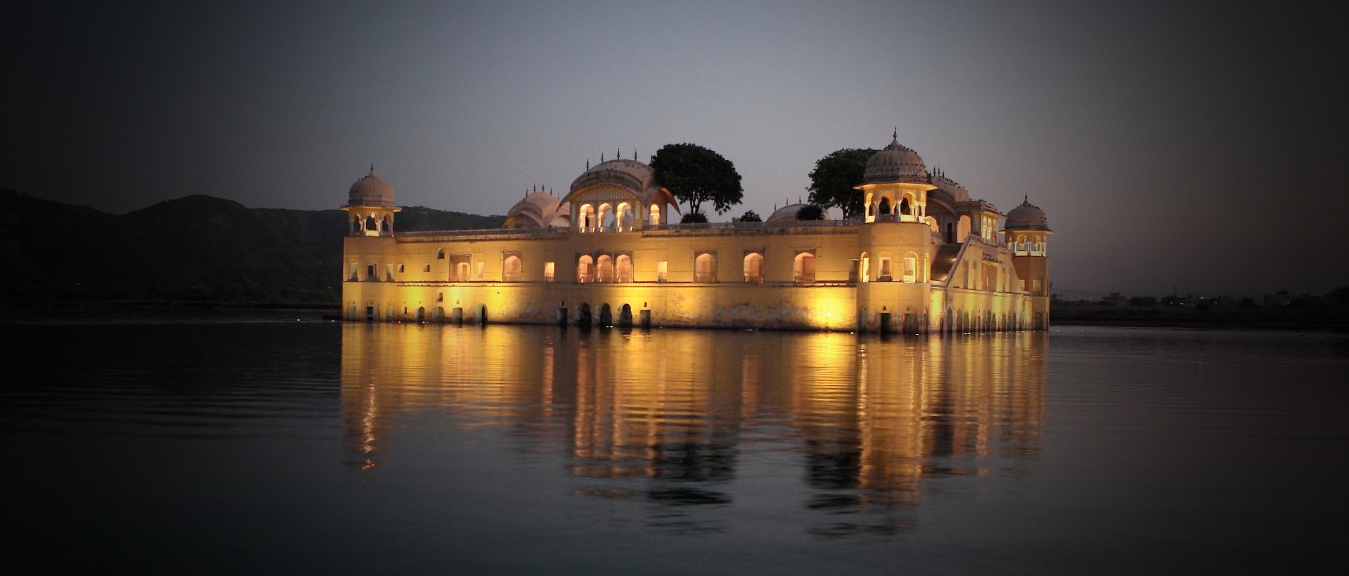
Jal Mahal ("Water Palace") is a palace located in the middle of the Man Sagar Lake in Jaipur, the capital of the Indian state of Rajasthan. The palace was originally constructed around 1699; the building and the surrounding lake were later renovated and expanded by Maharaja Jai ??Singh II of Amer in the early 18th century.
The Jal Mahal is a grand architectural display of the Rajput architectural style (prevalent in Rajasthan). The building commands a panoramic view of the Man Sagar Lake, but being isolated from the land, it is also worth viewing from the Man Sagar Dam on the eastern bank of the lake, set against the backdrop of the surrounding Nahargarh ("tiger-abode") hills. Built of local sandstone, the palace is three stories tall, with the third floor only on the eastern side of the palace. The eastern side is not visible from the public promenade along the road, which is the western side of the palace. The additional lower floors on the eastern side remain underwater when the lake is full. The Jal Mahal has a terrace with a garden, and the garden has four tibaris facing north, south, east and west. The tibaris are designed in the Bengal terrace style architecture, while four octagonal chhatris on the terrace mark the corners of the monument. The palace has previously suffered subsidence and partial seepage (damage to the plaster work and walls due to rising humidity) due to waterlogging, which has been repaired under a restoration project of the Rajasthan government.
The hills surrounding the lake area to the northeast of Jaipur contain quartzite rocks (with a thin layer of clay), which are part of the Aravalli mountain range. The rocks present on the surface in parts of the project area have also been used to construct buildings. From the northeast, the hills of the Kanak Vrindavan valley, where a temple complex is located, slope gently towards the lake shore. Within the lake area, the ground area is composed of clay, blown sand and a thick layer of alluvium. Deforestation, especially in the hilly areas, has led to soil erosion by the action of wind and water. As a result, silt deposited in the lake gradually raises the lake bed. On the terrace of the palace, a garden with arched passageways was created. Semi-octagonal towers with a beautiful dome were built at each corner of this palace.
The restoration work done in the early 2000s was not satisfactory and an expert in the field of similar architectural restoration works of Rajasthan palaces removed the recently done plaster, and checked the original designs present on the walls to make sense of them. Based on this conclusion, the restoration work was done again with traditional materials for plaster - the plaster consists partly of organic materials: jaggery, guggal and fenugreek powder are added to a mixture of lime, sand and surkhi. It was also observed that water seepage was almost negligible, except for a little moisture on the floors below the water level. But the original garden present on the roof was destroyed. Now, a new roof is being built based on a similar roof garden of Amer Palace. The building is located on the banks of a lake which has a maximum depth of 15 feet. Since all four floors of the building are built underwater, it means it will be built on the bottom of the lake.

Restoration work
In 2004, the Rajasthan Tourism Development Corporation signed an agreement with Jal Mahal Resorts, under which it was given a 99-year lease to develop 100 acres of land along the Man Sagar Lake (in the middle of which the Jal Mahal is situated) and the palace. This 99-year lease was given to Jal Mahal Resorts Private Limited, a special purpose company formed under the terms of the PPP project. Since 2005, the company has been working on cleaning the lake, reviving the ecology of the area and restoring the palace. In the future, Jal Mahal Resorts Private Limited plans to create a tourist destination around the Jal Mahal and make it a landmark tourist destination for all tourists visiting the city of Jaipur.
Joint Sector Project
Renovation of Jal Mahal in 2011.
The Lake Restoration Project of the Man Sagar Lake Area, with an estimated investment of ?1.5 billion, equivalent to approximately $18 million (considered one of the largest and unique projects of its kind in India), has drawn up a plan that includes diverse project components. As a result, the project has multiple stakeholders and beneficiaries. The project stakeholders are: Government of Rajasthan and its subordinate organizations such as Public Works Department (PWD), Rajasthan Urban Development Authority (RUIDP), Jaipur Development Authority (JDA - the nodal agency for implementation of all aspects of the project), Department of Tourism, Rajasthan Project Development Fund (RPDF) and Rajasthan Tourism Development Corporation (RTDC) and an Empowered Committee on Infrastructure Development (ECID); Central Government organizations involved with planning and financing are Ministry of Environment and Forests (MOE&F) through its National River Conservation Programme (NRCP) and ILFS.
The appointed Private Sector Developer (PSD) was M/s KGK Consortium. Under the Public-Private Sector Partnership model approved by EICD, PDCOR had prepared a Detailed Project Report (DPR) for restoration of Man Sagar Lake, restoration of Jal Mahal and lake complex development. The total project area for restoration and development approved by ECID was 432 acres (175 ha), comprising 300 acres (120 ha) of lake with water spread, 100 acres (40 ha) of lake complex area including 15 acres (6.1 ha) of submerged land for tourism development under joint sector cooperation and 32 acres (13 ha) for lake resort and tertiary treatment facility and related works.
The studies indicated two approaches to deal with the environmental degradation in the lake, namely, dealing with the natural catchment area as well as addressing the serious problem of municipal sewerage arising out of large-scale urbanization or human settlement. Keeping this comprehensive planning approach in mind, the following works were carried out under the lake restoration project: re-alignment of city drains, de-silting of the lake, construction of main road from Ambar to Man Sagar Dam (about 2.7 kilometres (1.7 mi)), construction of check dam 100 metres (330 ft) in length by de-silting the lake, construction of three nesting islands for migratory birds, lakeside promenade of 1 kilometre (0.62 mi), afforestation and treatment of forest area of ??the lake catchment area, plantation of trees to stabilise the slopes of bank construction. Afforestation included planting of local plant species such as Acacia arabica (desi babool) and Tamarix indica (planting near the water edge where they can grow well), Terminalia arjuna (Arjuna) Further, to remove eutrophication of the lake water and improve its water quality, an in-situ bioremediation process with 140 diffusers and 5 air compressors was also envisaged to aerate and create inversion of the lake bed and stored water. The city sewage, which supplied 7.0 MLD of untreated sewage, was treated by a sewerage treatment plant (STP) and then transported to maintain the water level of the lake, after removal of nutrients through tertiary treatment. The process involved diverting the Brahmapuri drain to the south into the Nagatlai drain by a lined channel. It was then transported through a treatment plant on site to generate secondary level effluent, which was then discharged through a water hyacinth channel into an artificial reservoir. was discharged into the wetland. For this purpose, a physico-chemical treatment plant was also envisaged and the effluent from this plant was taken through an artificially created wetland in an area of ??4 hectares (9.9 acres) (not only for water treatment but also to serve as a natural habitat for birds) and through this process the entire ecosystem is being regenerated. The vegetation generated in the process is disposed of in a compost pit near the lake.
It is also reported that about 500,000 cubic metres of silt was dredged from the lake. This silt was used to strengthen the embankment and to create islands as winter habitats for migratory birds.
After most of the above initial restoration works of the lake and its feeder system by the JDA were completed, during 2003, private sector developers were invited to develop identified tourism components on the land adjoining the lake. After following due procedure, the JDA of the Government of Rajasthan and private sector developers signed a MoU with the JDA to develop tourism components on the land adjoining the lake. A joint sector venture called PDCOR was formed between the consortium of developers, led by M/s KGK Enterprises. The tourism development project was assigned to this joint group. This tourism project included development of Convention Centre and Art Gallery, Mull.
Gallery
Map ( Click on the photo, the map will open )
Popular Pages on World Trip Plan